The apparent lack of enforcement, combined with aggressive and often dangerous driving behaviors, reflects a deeper mix of cultural, institutional, and infrastructural factors.
Is there traffic law enforcement in Georgia?
Yes—but it’s mostly automated, not hands-on.
- Speeding, bus lane violations, red-light running, and illegal parking are primarily monitored via automated cameras and license plate recognition systems.
- Fines are issued by mail or online, not by being pulled over.
- Police patrols rarely stop drivers unless it’s an accident, a DUI checkpoint, or a serious infraction that affects other crimes.
This “low-touch” model is deliberate: after the 2004 police reforms, Georgia moved away from routine traffic stops to reduce corruption and bribery.
Result: Traffic enforcement exists—but it’s mostly invisible, passive, and doesn’t address the culture of aggressive driving.
Why does the driving behavior seem so bad?
Cultural / social habits:
- “Rule-bending” is normalized — Georgian drivers often view laws as guidelines, not absolutes. Doing what works in the moment—cutting through a parking lot, reversing down a one-way—is part of the logic.
- Hierarchy on the road — Larger, newer, or more expensive vehicles often assume the right-of-way. “Me first” driving reflects broader status signaling.
- Low trust in state enforcement — Many people don’t expect rules to be applied fairly or consistently, so they adopt a “survival of the fittest” mindset behind the wheel.
Infrastructure & design:
- Lane markings are poor or inconsistent, and roads are often narrow and congested.
- Pedestrian infrastructure is weak, with drivers encroaching on crosswalks and sidewalks.
- One-way street logic is sometimes arbitrary, making illegal shortcuts tempting.
What do the police do?
The Patrol Police Department, under the Ministry of Internal Affairs (MIA), has broader responsibilities than just traffic. Their key functions include:
| Function | Comment |
|---|---|
| Responding to accidents | They come after collisions—not before |
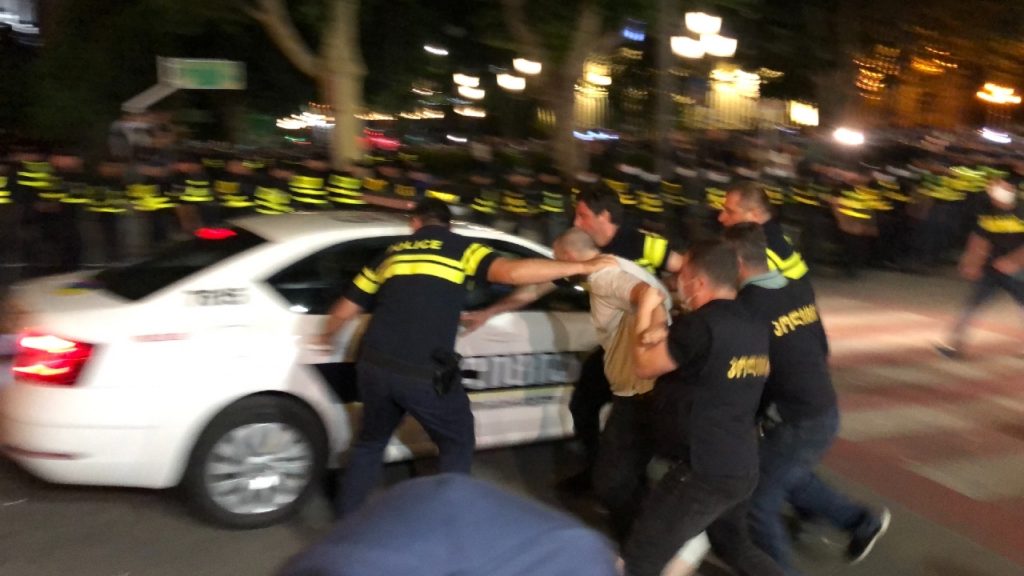
| Public order and protest management | Especially high-profile during political rallies |
| DUI enforcement | Occasional checkpoints, often around holidays |
| Camera-based enforcement | Operated via Smart MRE (“Safe City”) platform |
| Crime prevention patrols | Theft, violence, narcotics—not minor infractions |
But on a day-to-day street level, they rarely engage directly with minor traffic violations. Most visible activity is at intersections only when the power goes out, or during VIP motorcades.
Does the automated system work at all?
To some extent:
- Over 1 million traffic fines are issued annually, most by speed or red-light cameras.
- Online payment systems are widely used and integrated with vehicle registration; fines must be paid to renew registration.
- Repeat offender lists exist, and points are tracked—but the thresholds for license suspension are high.
Still:
- Many infractions (e.g., backing up a one-way street, blocking intersections) are not detected by cameras and therefore go unpunished.
- Scooters and motorcycles often lack visible or valid license plates, making them invisible to enforcement.
Why don’t police pull people over?
| Reason | Explanation |
|---|---|
| Anti-corruption legacy | After 2004’s Rose Revolution, roadside bribe culture was deeply rooted. Eliminating traffic stops was a way to break it. |
| Lack of manpower | The ratio of patrol officers to vehicles in motion is low, and traffic control is not prioritized. |
| Public tolerance of chaos | There’s little political or societal pressure to change current behavior unless it causes fatal accidents or blocks VIP movement. |
| Technology dependency | Authorities have invested in camera infrastructure, which they see as more efficient and less prone to abuse. |
What’s being done now
- New traffic cameras continue to be installed, including facial recognition at major intersections.
- Proposals for point-based license suspension reforms have been floated in Parliament, but enforcement gaps persist.
- NGO pressure (e.g., Partnership for Road Safety) is growing but still marginal compared to political reform priorities like EU integration.
Bottom line
Georgia has laws but not active enforcement on the street. The combination of a camera-heavy, passive model with cultural norms of flexibility and a trust gap in institutions results in chaotic driving with little direct consequence.
If you don’t see anyone getting pulled over, it’s not an accident—it’s the system by design, and it’s unclear whether that’s changing anytime soon.
